 6 hours ago
3
6 hours ago
3

Upgrade to High-Speed Internet for only ₱1499/month!
Enjoy up to 100 Mbps fiber broadband, perfect for browsing, streaming, and gaming.
Visit Suniway.ph to learn
Already have Rappler+?
to listen to groundbreaking journalism.

HAZE. Metro Manila experienced hazy air conditions on September 1, 2026, due to smoke from forest fires in Kalimantan, Indonesia, blanketing the sky. The Manila local government advised residents to take precautions and wear face masks when going outdoors.
Rappler
‘The Philippines also had some domestic issues that they need to deal with. Remember, there was this flood control-related issue, and that's significantly slowed down public investment,’ AMRO chief economist Dong He says
- AMRO has revised its Philippine growth forecasts for 2026 and 2027 down to 3.3% and 4.6%, respectively, due to the impacts of the Middle East energy shock and a slowdown in public investment linked to flood control issues.
- The Philippines is experiencing significant economic challenges, including high inflation and reduced private consumption, exacerbated by domestic issues and delayed infrastructure projects following corruption allegations.
- Despite these challenges, there are positive factors such as remittances and a stable IT-BPM industry, but recovery will depend on the speed and quality of public investment and government spending.
MANILA, Philippines – The ASEAN+3 Macroeconomic Research Office (AMRO) cut its Philippine growth forecasts for 2026 and 2027, pointing to the combined negative impacts from the Middle East energy shock and a slowdown in public investment linked to the flood control controversy.
AMRO now expects the Philippine economy to grow by only 3.3% in 2026, down from its 4.1% forecast in July. Its 2027 growth forecast was cut to 4.6% from 5.5%. In contrast, the wider ASEAN+3 region is expected to grow 4.1% in both years, with Vietnam showing particularly strong growth at 8.0% in 2026 and 7.6% in 2027.
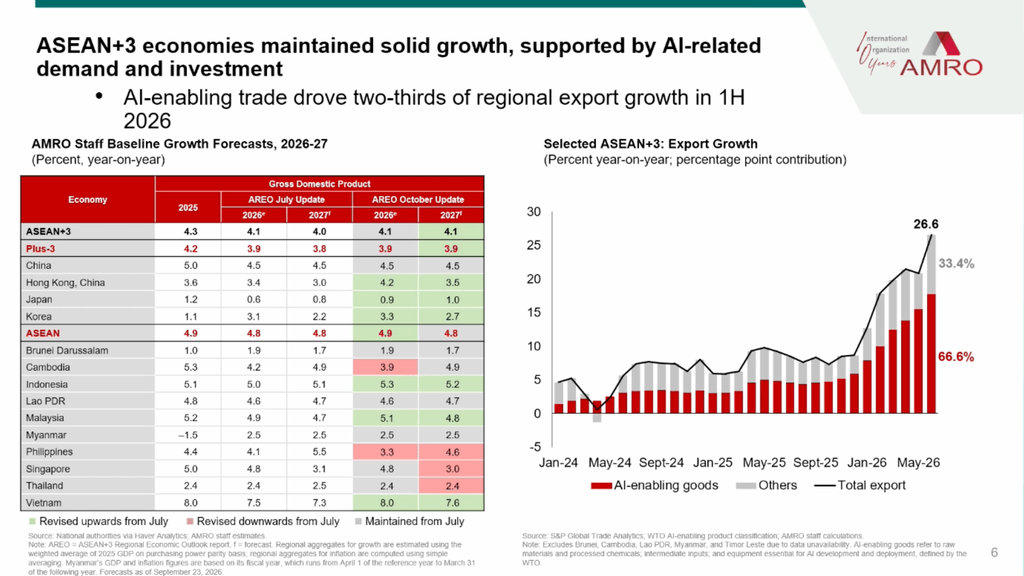 NEW OUTLOOK. The table shows that AMRO has cut the Philippines’ growth outlook for 2026 and 2027. Photo from AMRO briefing.
The October update is yet another downgrade from AMRO’s assessment after its annual consultation with Philippine authorities in August, when it expected growth of 3.4% this year and 4.8% next year. At the time, it already flagged weaker private consumption due to higher prices alongside subdued investment.
In its latest update, AMRO also pointed to persistent high global oil prices and its effect on energy.
“The Philippines is one of the economies that was hit harder by the energy shock,” AMRO chief economist Dong He said during a briefing on Monday, October 5. “Growth did slow down significantly and the inflation went up very quickly.” (READ: DOE sees ‘no signs’ oil prices will fall as excise tax relief goes on table)
But AMRO said the slowdown cannot be blamed on external conditions alone.
“The Philippines also had some domestic issues that they need to deal with. Remember, there was this flood control-related issue, and that’s significantly slowed down public investment,” He said.
“So the growth outlook is very dependent on how fast public investment and construction-related activities can pick up,” he added.
In a July analysis, AMRO said infrastructure projects had been delayed or cancelled following corruption allegations that emerged in mid-2025. It estimated that public construction contracted 31.5% year-on-year in the first quarter of 2026.
The financial stability report similarly said foreign investors had pulled money out of Philippine equities, reflecting what AMRO said were “investor concerns over the Philippines’ widening current account deficit, delayed infrastructure implementation, and the potential implications for growth and corporate earnings.”
There are still buffers. He pointed to remittances and the country’s IT-BPM industry, while saying the Philippines has clear monetary and fiscal policy frameworks. But he stressed that the recovery would also depend on the quality and pace of government spending.
Authorities should ensure that “public investment, well-governed public investment, can pick up speed,” He said, calling this important for the economy to return to its potential growth rate.
The World Bank likewise warned that the fallout from the flood control corruption controversy was weighing on the economy through weaker investment. In August, the World Bank said heightened scrutiny and audits of infrastructure projects had delayed spending and made private investors more hesitant, contributing to its decision to cut its 2026 Philippine growth forecast to 3.7% from 5.3%. – Rappler.com

How does this make you feel?
Loading