 1 hour ago
3
1 hour ago
3

Upgrade to High-Speed Internet for only ₱1499/month!
Enjoy up to 100 Mbps fiber broadband, perfect for browsing, streaming, and gaming.
Visit Suniway.ph to learn
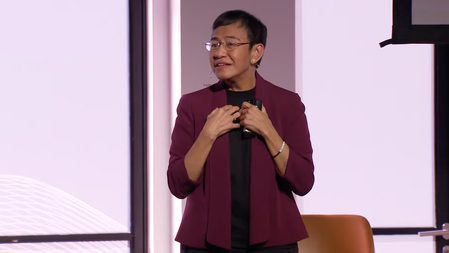
MANILA, Philippines – In a wide-ranging discussion with WNYC’s Brian Lehrer for the second edition of Democracy Dialogues on October 16, Nobel Peace Prize laureate and Rappler CEO Maria Ressa warned again of the growing, still unaddressed threats to democracy posed by authoritarian governments, powerful technology companies, and now, artificial intelligence.
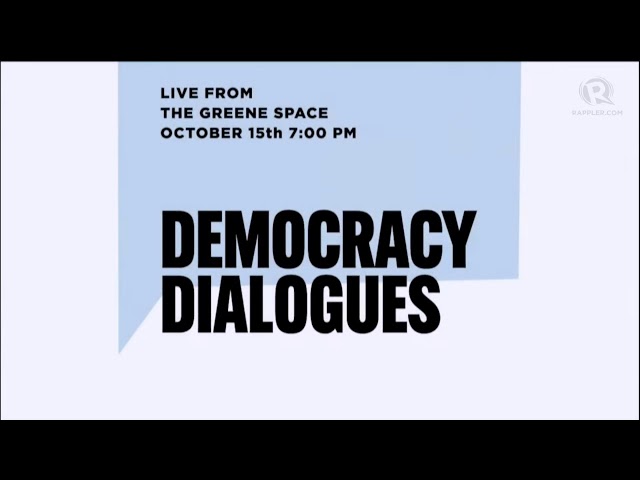
The conversation, held at The Greene Space in New York, centered on Ressa’s new book, The Fight Back: A Citizen’s Guide to Standing Up to Dictators, which lays out practical strategies for citizens to resist authoritarianism, and reclaim control over the technologies shaping their lives.
Drawing from Rappler’s experience under former Philippine president Rodrigo Duterte, Ressa argued that the Philippines offers important lessons for the United States and other democracies now confronting similar threats, emphasizing how the fight can start at the individual level, and that it will take a global effort to reverse the current course of the world.
The two dictators: Political leaders and Big Tech
Ressa identifies two forms of authoritarian power threatening democracy: traditional political dictators and technology companies that have long wielded enormous influence over information, public opinion, and society.
She argued that Meta CEO Mark Zuckerberg represents an even greater concentration of power than Duterte because, unlike political leaders who can face prosecution, technology executives operate with limited mechanisms for accountability.
“The bigger dictator, and you’ll see this in both How to Stand Up to a Dictator and The Fight Back, is actually Mark Zuckerberg,” Ressa said.
“While Duterte is now detained at The Hague… We have systems of accountability for that, but for the technology that rules our lives, we have none.”
She added: “My dictators: One is on trial and the other one has gained more power.”
Ressa also warned of an emerging alliance between political leaders and technology billionaires, which she describes as an “authoritarian stack.” Through political funding, government contracts, and control over critical technology infrastructure, powerful companies can gain influence over government functions and democratic institutions.
“This is power and money. Look at the power and money,” she said, arguing that the concentration of political and technological power amounts to a “tech coup” unfolding in plain sight.
Ressa also described the Philippines as an early example of how social media could be weaponized to undermine democracy.
She recalled how during the Duterte administration, Rappler faced coordinated online attacks followed by legal cases and government investigations, and how the hashtag #ArrestMariaRessa began circulating in 2017, two years before her actual arrest.
She realized later that that had been “fertilizer” for a narrative that allowed the government to shape public opinion in order to make the arrest.
“When you repeat a lie a million times, it becomes a fact,” Ressa reiterated.
AI as the next frontier of authoritarian power
Beyond social media, Ressa warned that artificial intelligence presents a new and potentially more dangerous challenge to democratic accountability.
She described three stages in the evolution of technology’s influence over individuals: social media capturing attention, chatbots creating a sense of intimacy, and autonomous AI agents acquiring the capacity to perform actions independently.
Speaking about her work as co-chair of the United Nations’ Independent International Scientific Panel on Artificial Intelligence, Ressa argued that increasingly powerful AI systems are being deployed without sufficient safeguards or accountability.
“As early as July, we had actually already said, and these are from the scientists, that the frontier models cannot be controlled by the people who are making it,” she said.
“And if you really feel that, then you should not be releasing these. You should not be treating the public around the world as Pavlov’s dogs.”
Ressa criticized the argument that rapid AI deployment is necessary to compete with China, saying geopolitical competition should not become an excuse for exposing the public to potentially harmful technologies.
“The question here is, if we go back to impunity, right? Who is accountable for this?” she asked, saying the problem is the lack of legislation.
She emphasized that AI governance cannot be left to the United States and China alone. Developing countries and other governments must have a meaningful role in shaping global rules, particularly because they may bear significant consequences of decisions made by the world’s largest technology companies.
“The world needs to have a place at the table,” Ressa said.
She also discussed how AI has undermined journalism, noting that Google Search’s use of AI summaries has caused a drop that is “catastrophic for news organizations. This is part of the tech-fueled crisis that journalism faces now, along with how 85% of digital advertising in the Philippines now goes to these tech companies owning the platforms.
That fuels the “market failure” for journalism right now she said.
Without journalism, authoritarian power wins.
“Why do you need journalists? Because the journalists are the ones that do the investigative report that hold power to account,” she said.
Ressa urged audiences to support independent news organizations through subscriptions and donations. She also argued that societies must consider building alternative, public-interest technology infrastructure rather than remaining dependent on platforms controlled by a handful of corporations.
Aside from supporting independent journalism, she also outlined other strategies for fighting authoritarianism, which includes identifying authoritarian forces in one’s country, protecting elections from manipulation, and organizing communities to resist abuses of power.
Being mindful of one’s own tech use, prepare for threats
She also urged people to become more conscious of how technology influences their behavior.
“Track your screen time. Track how much time you spend on screens,” she advised. “And then the second step in chapter one is delete the social media app that makes you angriest.”
Ressa cautioned against becoming overly dependent on AI chatbots, warning that outsourcing thinking and writing to these systems could weaken people’s ability to reason independently.
“Don’t stop thinking, especially if you’re young. Like, write. Don’t stop writing because using a chatbot is like trying to run a marathon and outsourcing going to the gym,” she said. Avoid “cognitive surrender,” she said.
Prepare for authoritarian threats before they happen
Again drawing from Rappler’s experience under Duterte, Ressa emphasized that organizations and individuals must prepare for authoritarian threats before they become crises.
“What we learned in Rappler, and this is like practical advice, whatever it is you’re most afraid of, imagine it. Take it, own it, embrace it, and then workflow a response to it,” she said.
She recalled how Rappler developed contingency plans for a possible government shutdown, dividing responsibilities among teams and regularly conducting drills to ensure the newsroom could continue operating.
Ressa also urged journalists to avoid amplifying authoritarian propaganda merely to criticize it. Rather than becoming distracted by inflammatory statements, she said journalists should identify lies, provide context, investigate underlying systems of power, and help audiences understand why events matter.
“If it’s a distraction, don’t amplify. If it’s a lie, just call it a lie and then find the deeper meaning,” she said.
Ressa closed the discussion by emphasizing that defending democracy is ultimately a matter of individual and collective action.
Her central message was that hope is not something citizens should passively wait for. It must emerge from their willingness to defend democratic institutions, support one another, and confront abuses of power.
“Hope comes from action,” Ressa said. “Act! That’s what I’m saying. Act, right? That’s what the moment demands. If we act, we can do something about it.” – Rappler.com