 41 minutes ago
5

Upgrade to High-Speed Internet for only ₱1499/month!
Enjoy up to 100 Mbps fiber broadband, perfect for browsing, streaming, and gaming.
Visit Suniway.ph to learn
Already have Rappler+?
to listen to groundbreaking journalism.
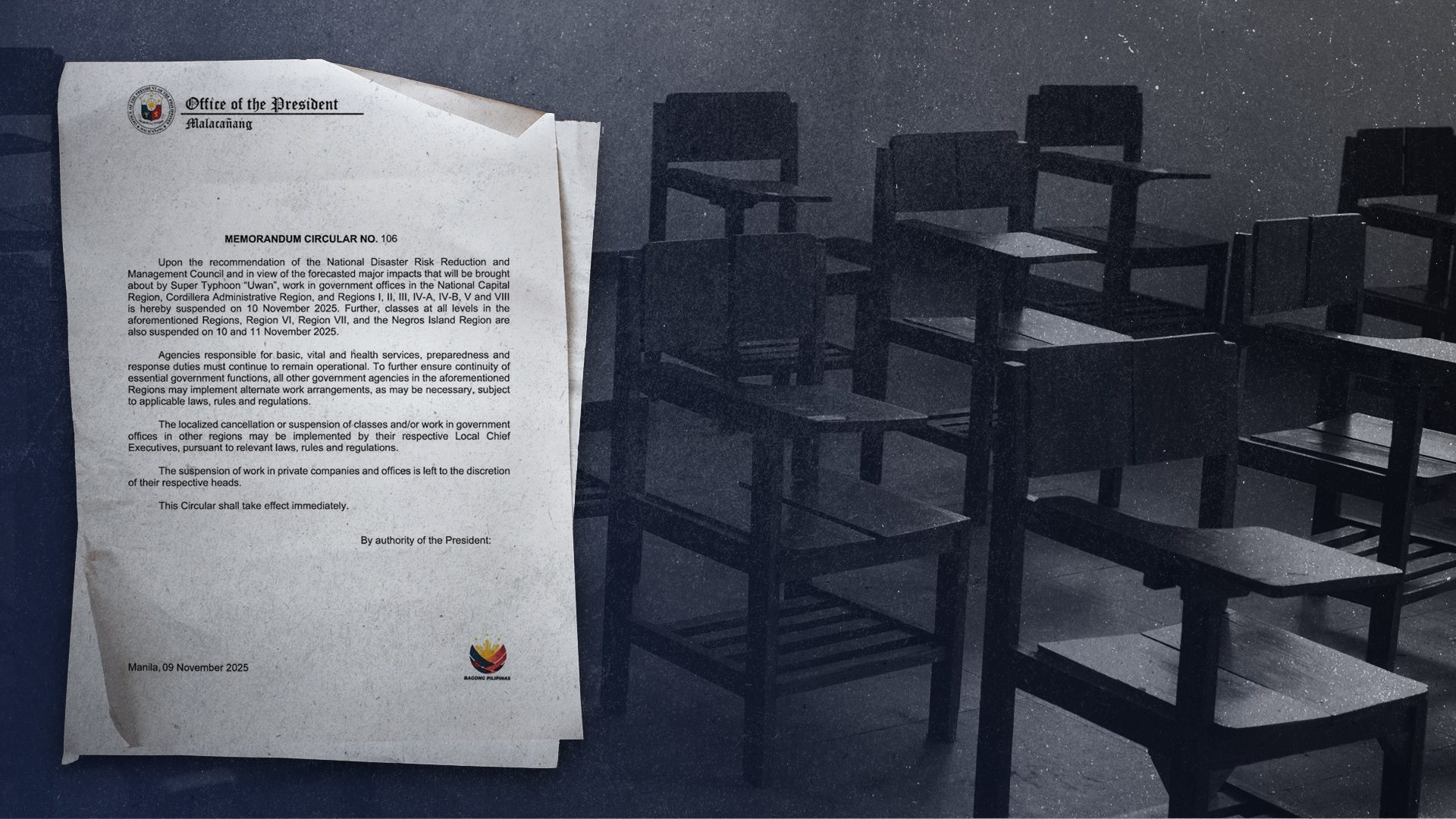
President Ferdinand Marcos Jr.’s new executive order seems to be an EO that Malacañang itself badly needs, after a string of blanket class suspensions
“Talaga lang ha?” was my initial, no-filter reaction when Malacañang announced that President Ferdinand Marcos Jr. had signed an executive order (EO) establishing a framework for class suspensions and resumptions.
EO No. 130 explicitly allows for area- and school-level decisions to be made on when to suspend or resume classes — a targeted approach as opposed to blanket orders covering entire provinces or even regions.
Hello, I’m Acor Arceo, head of news operations at Rappler. I also oversee our coverage of the education sector and disasters, among others, which explains why I was probably the most skeptical in our newsroom when Marcos’ new EO was publicly released on Tuesday, November 3.
When I instructed our education reporter Jelo Ritzhie Mantaring to write an article on the EO, I also pointed out that Malacañang had often been the one to step in and declare blanket class suspensions — in trigger-happy fashion, really.
It was like the Palace gave itself the order it badly needed.
Let’s backtrack a bit to 2025. Remember when Interior Secretary Jonvic Remulla drew flak for his flippant way of announcing class suspensions? The approach that made him a social media star as Cavite governor had the opposite effect when he took it to the national stage. At the time, the focus was on Remulla’s choice of words and overall tone, which lacked the formality befitting his position and the gravity of the situation.
There were also instances when Remulla’s announcements somehow excluded one or more affected provinces, raising even more questions about whether or not he was making well-informed decisions.
Thankfully, the poorly worded social media announcements from the Department of the Interior and Local Government eventually stopped. What didn’t stop back then, however, was Malacañang’s blanket class suspension policy.
Up until last September, the Palace was still suspending face-to-face classes for entire areas, seemingly disregarding the fact that these areas were facing different weather conditions and varying risk levels. Sure, there was a line in each Malacañang memorandum acknowledging the authority of local chief executives to decide for their respective cities, municipalities, or provinces, but who would deviate from an order that already came from the top?
In one instance, the Palace suspension order came late afternoon, when school and work hours were almost over. People could only shake their heads and wonder: a) Is this supposed to be for tomorrow? b) Is Malacañang in a different timezone? c) Is this even for real?
The executive branch also seemed to have forgotten that every school day counts in a country facing a severe learning crisis. This is not to say that we should make students go to class at all costs, without care for their safety. It’s about ensuring that those who can safely attend classes are actually able to do so, instead of them automatically being lumped together with students in areas facing harsh conditions.
Implementing guidelines for Marcos’ new EO are expected to be released within 30 days. Join us in scrutinizing the guidelines once they’re out. – Rappler.com
Inside the Newsroom is a newsletter delivered straight to your inbox every week. Visit rappler.com/newsletters to manage your newsletter subscriptions.
How does this make you feel?
Loading