
 48 minutes ago
3
48 minutes ago
3

Upgrade to High-Speed Internet for only ₱1499/month!
Enjoy up to 100 Mbps fiber broadband, perfect for browsing, streaming, and gaming.
Visit Suniway.ph to learn
After days of dilly-dallying, President Ferdinand Marcos Jr.’s administration ordered the arrest of International Criminal Court (ICC) suspect Senator Bato dela Rosa.
Acting Department of Justice (DOJ) Secretary Fredderick Vida said the Philippine National Police (PNP) and National Bureau of Investigation (NBI) have been ordered to implement Dela Rosa’s ICC warrant on Thursday, May 21.
The DOJ gave the order a day after the Supreme Court junked Dela Rosa’s request for a temporary restraining order to block his warrant. Marcos gave the command now that Dela Rosa is in hiding again after escaping from the Senate on May 14.
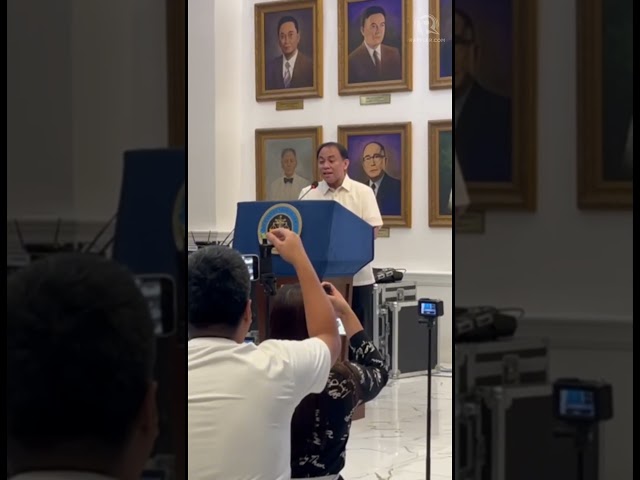
Nevertheless, what happens to Dela Rosa now and how do authorities intend to deal with him?
Ready to arrest Dela Rosa
In a statement on Thursday, PNP chief Police General Jose Melencio Nartatez Jr. said that the police recognize the authority of government agencies — presumably pertaining to the DOJ — to implement orders.
“As a law enforcement agency, the PNP shall perform its mandate in accordance with existing laws, due process, and established operational procedures,” the top cop said. “The PNP likewise assures the public that all actions undertaken shall remain impartial, professional, and within the bounds of the law, with full respect for the constitutional rights of all parties concerned.”
Meanwhile, NBI Director Melvin Matibag said his bureau “has been consistent in its position” that Dela Rosa must be arrested through the ICC warrant.
“The order is to arrest Senator Dela Rosa, so we’ll do so without delay,” said Matibag.
What happens after arrest?
Like in Duterte’s case, it’s the PNP Criminal Investigation and Detection Group (CIDG) that will implement the warrant against Dela Rosa. The CIDG handles the high-profile cases of the police.
On Friday, May 22, CIDG chief Police Major General Robert Morico II said that Dela Rosa is still in the Philippines. As of Thursday, May 21, Bureau of Immigration spokesperson Dana Sandoval said they have no records of Dela Rosa leaving the country.
Meanwhile, after arrest, Morico said Dela Rosa will be brought to the CIDG office inside Camp Crame in Quezon City, where he will undergo standard booking procedures for arrested suspects.
“We will be turning him over, after all [the] booking procedures, to the Department of Justice. It is up for the concerned government agency to decide. We will wait for the order,” the CIDG chief.
Vida was already asked on Thursday about their plans after Dela Rosa’s arrest, but he refused to answer, saying those are operational matters that cannot be disclosed publicly. The DOJ, on Friday, maintained the same position.
“The procedure to be followed pertains to operational matters that cannot be publicly disclosed so as not to defeat the ultimate objective to bring him to the ICC and exact justice,” DOJ spokesperson Prosecutor Polo Martinez told reporters on Friday.

Can Bato be under PNP’s protection?
Last week, Department of the Interior and Local Government (DILG) chief Juanito Victor “Jonvic” Remulla confirmed that Dela Rosa sought to be under police custody.
“It was part of a conversation but [there was] nothing definitive,” Remulla told Rappler on May 14.
On May 15, Vida said that if Dela Rosa wants, he could also be placed under the department’s protective custody: “The DOJ would be more than willing to make arrangements with him…. He’s an elected senator of the country…. He has lawyers to protect his rights.”
These statements raised confusion because Dela Rosa is a suspect that needs to be arrested, and not a witness that should be placed under protective custody.
Finally, on Friday, Nartatez ended the confusion by saying that Dela Rosa being placed under custody would be considered a surrender, and therefore an arrest.
“Seeking protective custody, meaning, that is surrender,” said the PNP chief.

Will Bato be sent straight to The Hague?
The Marcos administration has the option to use the “Duterte” track. This means following the procedures when it arrested the former president in 2025, invoking Republic Act (RA) No. 9851 or the domestic International Humanitarian Law.
Under the law, the Philippine government may directly surrender a suspect to international courts. Marcos’ Office of the Solicitor General, the government’s primary legal counsel, said this is the process that should be followed too in Dela Rosa’s case.
“…The authorities may surrender or extradite suspected or accused persons in the Philippines to the appropriate international court, if any, or to another State pursuant to the applicable extradition laws and treaties,” says RA No. 9851’s Section 17.
ICC assistant to counsel Kristina Conti explained that the ICC warrant would be implemented according to national procedures. In this case, Rule 113 of the Rules of Court, which defines and explains how an arrest should be made locally, would apply.
After the arrest, local authorities may then turn over Dela Rosa to the ICC, as it did with Duterte.
When the former president was arrested last year, his camp argued that he should have been brought first before a competent judicial authority, based on the Rome Statute’s Article 59. The Rome Statute is the treaty that created the ICC.
Article 59’s purpose is to ensure that:
- the warrant applies to that person
- the person was arrested following proper process
- the person’s rights were respected
However, there have been differing opinions within the legal community over whether the Philippines is bound to follow Article 59. This is especially because the country is no longer a member of the ICC because of Duterte’s withdrawal from the statute that took effect in 2019.
Even Marcos’ OSG believes that RA No. 9851’s section 17 “cannot be made contingent upon, or read together with, the procedure prescribed under Article 59.”
“Article 59 of the Rome Statute is not applicable to Dela Rosa’s case, since Philippine domestic courts cannot apply a treaty that does not have the legal force and effect of domestic law in the Philippines,” ICC common legal representative of the victims, Gilbert Andres, told Rappler.
Whether the DOJ will invoke RA No. 9851 or Article 59 remains unsure. But if it were up to the OSG, Dela Rosa should be sent straight to the ICC headquarters in The Hague, Netherlands. – Rappler.com