1 month ago
30
1 month ago
30

Upgrade to High-Speed Internet for only ₱1499/month!
Enjoy up to 100 Mbps fiber broadband, perfect for browsing, streaming, and gaming.
Visit Suniway.ph to learn
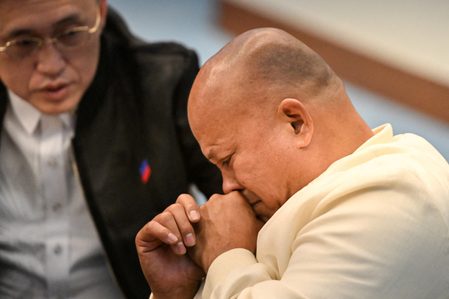
The Supreme Court has now denied Senator Ronald dela Rosa’s request for a temporary restraining order against the possible execution of an International Criminal Court (ICC) warrant.
It proves that the Court is neither unaware of the urgency nor institutionally incapable of acting with speed when confronted with politically explosive issues. The justices clearly understand the stakes. They know the nation is standing at the edge of a constitutional confrontation involving sovereignty, executive power, international law, and the legacy of Rodrigo Duterte’s drug war.
And yet, despite this demonstrated capacity to act decisively, the Court still refuses to provide comprehensive constitutional clarity on the larger legal questions surrounding ICC cooperation.
That is where the real problem lies.
The issues before the Court are not factual labyrinths requiring years of evidentiary hearings. They are not criminal trials demanding witness credibility determinations. They are fundamentally questions of law.
Bigger questions
Can the Philippine government cooperate with the ICC despite its withdrawal from the Rome Statute?
Does Republic Act No. 9851 still provide a framework for cooperation?
Can Philippine authorities execute requests connected to ICC processes?
What constitutional boundaries exist, if any?
These are legal questions. Pure legal questions. Questions the Supreme Court exists precisely to resolve.
Yet what the country continues to receive are fragmented procedural actions instead of definitive constitutional guidance.
Take, for instance, the habeas corpus petitions filed on behalf of Rodrigo Duterte. While the Supreme Court has already acted procedurally, it has not yet rendered a final substantive ruling on the merits. (READ: What are the legal issues in Duterte’s arrest and transfer to The Hague?)
The petitions were consolidated under several docket numbers, including G.R. Nos. 278763, 278768, and 278798. According to recent filings by Duterte’s camp, these consolidated petitions were filed on March 12, 2025.
The Supreme Court previously required government agencies to respond and later required the submission of memoranda, meaning the Court has already taken cognizance of the petitions. The parties reportedly completed their memoranda by late 2025 and early 2026.
However, Duterte’s lawyers recently complained that despite the passage of around 14 months, the Court has still not issued a substantive resolution. In a “Second Urgent Motion to Resolve,” they argued that the prolonged delay effectively undermines the very purpose of habeas corpus as a “speedy and effectual remedy.”
This delay is no longer easy to justify as mere judicial caution. In fact, the denial of Dela Rosa’s TRO may have unintentionally highlighted the inconsistency even further. The Court acted swiftly on provisional relief for a possible future arrest, yet continues to withhold a final constitutional resolution on the legality of Duterte’s surrender and the broader ICC cooperation framework.
That contrast is becoming institutionally difficult to ignore.
The longer the Court refuses to speak with clarity, the more it creates the impression that it is waiting not for legal illumination, but for political weather conditions to stabilize. That is a dangerous image for the highest tribunal of the land.

The Supreme Court cannot shield itself from scrutiny simply by issuing partial procedural actions while postponing the central constitutional reckoning.
Courts do not merely decide cases. In moments of national tension, they prevent constitutional uncertainty from mutating into political chaos. Delay itself becomes a decision when the consequences are enormous and immediate.
What makes the delay even more glaring is that the relevant legal terrain is not entirely unexplored. The Court is not being asked to interpret an alien legal universe. The petitions revolve around treaty withdrawal, executive cooperation, statutory interpretation, jurisdiction, and constitutional structure, areas the Court has confronted repeatedly in various forms.
Fear of consequences?
The issues may be politically explosive, but legally they are neither mysterious nor incapable of resolution.
This is precisely why the delay invites suspicion.
People begin to wonder whether the Court fears the consequences of its own ruling more than the absence of one. A judiciary that becomes excessively conscious of political backlash risks transforming itself from an independent constitutional organ into a spectator waiting for power blocs to settle their conflict first.
But constitutional courts are not designed to trail behind politics. They are supposed to confront constitutional crises before they metastasize.
The irony is painful. The Court often acts swiftly in cases involving electoral deadlines, budget disputes, or internal political quarrels among elites. Yet on a matter touching sovereignty, international accountability, executive power, and the surrender of a former president to an international tribunal, the institution suddenly discovers the virtues of caution and extended deliberation.
One begins to ask: if not now, then when exactly is judicial urgency appropriate?
The danger here extends beyond Rodrigo Duterte, Ronald Dela Rosa, or the ICC itself. The greater danger is the normalization of constitutional ambiguity during moments of maximum political consequence.
A Supreme Court that delays too long teaches future governments a dangerous lesson: that sufficiently controversial constitutional questions can simply be outrun politically while the judiciary remains frozen in procedural caution.
At some point, incremental procedural actions stop looking like prudence and start looking like institutional fear.
The country does not need theatrical language from the Court. It does not need moral grandstanding. It does not need carefully calibrated fragments of action designed to relieve immediate pressure without confronting the central constitutional issues.
It simply needs a ruling. A clear one. A timely one. And above all, one worthy of a tribunal that calls itself supreme. – Rappler.com
Raul F. Borjal is an alumnus of Ateneo de Manila University. He held senior executive positions in various domestic and multinational companies, culminating in his retirement as vice president and corporate secretary of a Filipino-owned group of companies.