 1 hour ago
1

Upgrade to High-Speed Internet for only ₱1499/month!
Enjoy up to 100 Mbps fiber broadband, perfect for browsing, streaming, and gaming.
Visit Suniway.ph to learn
BATANGAS, Philippines – In front of a house along the mangrove coast in Calatagan, Batangas, rafts and boats sat moored.
Jessie delos Reyes, 50, a slight-framed man who has lived in this house all his life, calls these rafts his floating classrooms; for more than half his life, he has dived in and out of the waters of the marine reserve just a few minutes away from his house.
He is known as Kuya Jessie of the floating houses in Calatagan. His name is familiar to locals, tourists, students, and marine scientists who come here for fieldwork and retreat.
The weather was fair that Tuesday morning in November. I joined Jessie on one of his dives to check the corals in Buntong Gasang, a coral monitoring site. The spot is a few minutes off the coast and not that deep. Buntong Gasang is adjacent to the Verde Island Passage, the famous waterway at the heart of the world’s Coral Triangle.
We used the floating classroom to go to Buntong Gasang. A motorized boat pulled the raft from the coast.
Three more divers made up Jessie’s team that morning — men who make a living teaching water safety skills, divers for nongovernmental organizations. That Tuesday, they were all volunteer divers for Calatagan Reef Patrollers or Carepas, which Jessie founded in 2004.
On the floating classroom, they moved at ease with their scuba diving equipment. On the table was a green thermos filled to the brim with kapeng barako (barako coffee) and bread for a quick breakfast.
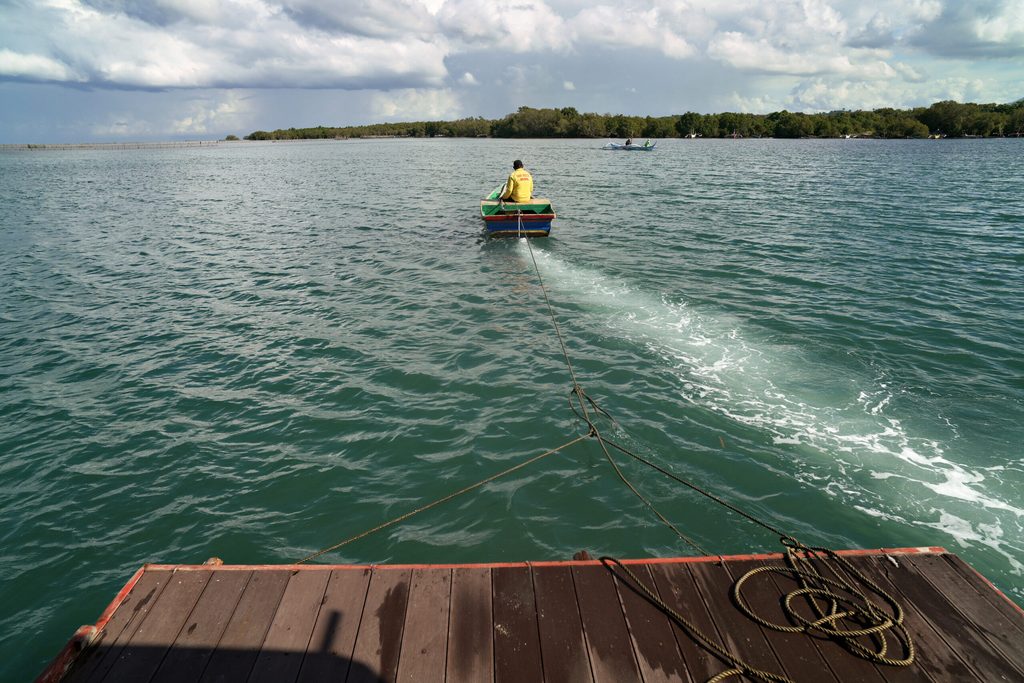 SITE. A motorized boat pulls the floating classroom to transport volunteer divers to the coral monitoring site. Photo by Franz Lopez/Rappler
They used a laminated coral health chart — composed of several shades of coral colors — from Australia’s University of Queensland. Divers hold this chart against the corals to compare colors and grade them properly.
When it turns 1 — or the palest shade of each color — it means the coral has bleached. Once they’ve identified the right shade of the coral with the chart, they write the grade on their slates. They submit these reports to authorities and experts.
During the dive, Jessie delegated tasks to the team. The safety diver entered the water first to check the current. Jessie laid the transect and collected data, with another diver tailing him to assist. Then another diver took photos and videos.
About 30 minutes later, after surfacing from the water, Jessie said there was good news and bad news. The good news: some of the corals that were bleaching a month ago showed signs of recovery.
“But the bad news is most of them were recently killed,” Jessie said after the dive. “There’s algae already. They were not able to recover.”
After many years of monitoring the corals in Calatagan, Jessie has become an advocate for “citizen science,” where community members work alongside scientists to monitor changes in the marine environment.
“The marine biologists, marine scientists, come and go,” Jessie said. “The community, even when their eyes are closed, even when they’re asleep, they know what’s happening in the community.”
 TRANSECT. Jessie delos Reyes holding a transect tape aboard the floating classroom while on the way to the coral monitoring site. Photo by Franz Lopez/Rappler
The promise of citizen science
Coral scientist Wilfredo Licuanan has always dreamed of municipal fisherfolk checking the health of corals and reefs all on their own.
Licuanan, called Al by family and colleagues, is a De La Salle University professor who specializes in coral reefs. He established the SHORE Center, La Salle’s research center that pioneered a citizen science program on coral reef monitoring.
Al, 63, grew up in Diliman, Quezon City — the third generation in their family to study at University of the Philippines (UP). He took up marine science as an undergraduate, only learning to swim the summer before his first semester, before later shifting to zoology.
At the former Marine Science Center (now Marine Science Institute) at UP, he was a research assistant to the inimitable Edgardo Gomez, the center’s founding director. He eventually left the center and joined the La Salle faculty in 1997.
The next year, he started to manage the university’s Br. Alfred Shields FSC Marine Station in Lian, Batangas. The marine station lies in the western part of Lian, facing the Verde Island Passage and the West Philippine Sea. Its location is accessible to divers in the province, including volunteers from neighboring Calatagan.
Al said he has spent most of his time at the marine station as much as he could. Back then, it was still plain and bare, built like a bunkhouse along the coast in the remote part of town.
From 2014 to 2017, Al and his team at La Salle’s marine center surveyed reefs for a national assessment. The sheer scale of the work led them to develop further methods non-scientists could also use to assess coral communities and local reefs.
This eventually became the Alwan method. Alwan, a Tagalog word meaning “to ease,” evolved from the work of local and foreign researchers: an individual is trained to identify butterflyfish and target marine invertebrates and corals at a selected survey station.
By the end of the program, trainees are expected to know how to safely conduct a survey on their own, identify target species to determine reef health, and monitor bleaching triggered by climate change.
 TRAINER. Wilfredo Licuanan stands on the bow as water safety training starts in waters off the coast of Lian, Batangas. Photo by Iya Gozum/Rappler
Forty years ago, when Al started his coral studies, he did not deliberately set out to promote citizen science.
There are not enough scientists, and it would be impossible to regularly check on reef health without the help of people who are most frequently at sea: the fishermen, sea patrol, locals, lifeguards, and even recreational divers.
“Those methods were actually an early form of citizen science in the sense that they were developed in Australia so that people who can dive but do not necessarily have the science training [can] do surveys in the Great Barrier Reef,” Al said.
On the field
A few weeks after my Calatagan visit with Jessie’s team, I joined Al and his SHORE Center staff in La Salle’s marine station in Lian. They had started training people from the Bureau of Fisheries and Aquatic Resources (BFAR) on how to monitor reefs.
It was another Tuesday morning at sea. The water was cold, and I was swimming toward the reef crest in front of the marine station, following Al toward a jutting rock. He moved deftly in the familiar waters, while I tried to keep up.
As we swam, the seafloor visible beneath me started to fade, and all I could see was blue. A few moments later, a blanket of dead staghorn corals appeared. I knew they were dead because of the fuzzy texture. Algae had grown and taken over.
Above water, Al told me that amid the dead staghorn corals, there were new, living ones.
“I’ll point them to you,” he told me. We swam a bit more, and the live staghorn corals were hard to miss. Staghorn corals have branches, and these had white tips.
Al later told me that meant they were still growing. I asked him how there could be living ones among the dead. It’s the current, Al said. Corals may be spawning in another part of the reef, or in another reef altogether, and the coral eggs and sperm made it to the area due to the current.
 SLATE. A diver takes note of target fish species on their slate. Photo from SHORE Center
A few minutes later, the BFAR staff who just finished water safety drills caught up with us at the reef. This was the first session of SHORE’s training for the BFAR. Among this session’s participants were the Carepas volunteer divers I visited in Calatagan weeks before.
Climate crisis and the decline of local reefs
Through the coral reef assessment from 2014 to 2017, Al and his team found a “marked decline” in the condition of local reefs in the past four decades (since the first assessment was conducted from 1976 to 1981).
Many of their assessment stations were in Luzon, specifically in the Verde Island Passage. The marked decline in conditions led the team to report then that “the establishment of marine protected areas, and other interventions in the past 40 years have not caused an appreciable impact on overall reef condition in general, except in particular localities.”
“Mostly, it’s climate change,” Al said in an interview before their fieldwork in Lian.
“I keep saying it’s the most visible manifestation of climate change,” he added. “Because when the water is hot, that is not a localized event. It happens in large sections of the sea.”
 LEARNING. A research assistant from SHORE (right) helps a BFAR staff with her fins before the water safety training starts. Photo by Iya Gozum/Rappler
The world is already on track to exceed the 1.5 degree Celsius limit that countries set to avoid the extreme impacts of climate change. At this point, drastic steps should already be taken to cut down greenhouse gas emissions.
Maintaining ocean health by protecting coral reefs, mangroves, and seagrasses can help cut down emissions. Australia and Turkey, co-presidents of this year’s largest climate summit, put the ocean at the heart of the conference, yet the talks broke down after a final draft deal failed to mention fossil fuels.
A way of life
Back in Calatagan, the coast opposite Jessie’s house was lined with mangroves.
“We planted those mangroves on September 2, 2002,” he told me after that morning’s coral monitoring session. “We have mangroves, we have seagrass, we have corals. The ecosystem here is complete.”
Jessie grew up in Calatagan. His parents fished for a living, and Jessie himself was a fisherman before he became part of the sea patrol, became a lifeguard, learned to dive, and eventually founded his volunteer divers’ group.
 AFLOAT. The floating classrooms anchored in front of Jessie delos Reyes’ house in Calatagan, Batangas. Photo by Franz Lopez/Rappler
 UNDERWATER. Jessie delos Reyes conducting coral assessment on November 3, 2026, in Calatagan, Batangas. Photo from Carepas
More than two decades ago, he attended a course that Al used to teach: marine biology for non-biologists. (“I taught it on the weekends,” Al told me in a separate interview. “Jessie was in the class.”)
Jessie has already seen it all: corals bleaching and recovering, the devastating impact of El Niño events in recent history, and typhoons that wreak havoc underwater.
His desire to protect the ocean is something he may have inherited from his parents, Jessie said
— from fisherfolk who were at sea every day and who saw what a healthy ocean looked like and what it could give them. – Rappler.com
Quotes translated to English for brevity.
This story was produced with the support of Informed Earth as part of the COP31 Ocean Virtual Reporting Fellowship.