 2 months ago
55
2 months ago
55

Upgrade to High-Speed Internet for only ₱1499/month!
Enjoy up to 100 Mbps fiber broadband, perfect for browsing, streaming, and gaming.
Visit Suniway.ph to learn
Questions from several senator-judges about AI and deepfakes briefly shift attention to how digital evidence is authenticated in an age of synthetic media
MANILA, Philippines – Not even Sara Duterte’s impeachment trial can escape the question of artificial intelligence (AI).
Several senator-judges brought up AI as it relates to the Sara Duterte video that allegedly points to grave threats against President Ferdinand Marcos Jr., First Lady Liza Araneta-Marcos, and former House speaker Martin Romualdez.
First was Raffy Tulfo, who asked plainly whether the video was AI-generated. It wasn’t, according to witness senior NBI agent John Mark Calilung, based on his experience and “personal observation.”
His reasoning was that the video was two hours long, and that “normally an AI-generated video will only last a few seconds.”
There is some practical logic behind that observation. Fully AI-generated or heavily manipulated videos become more expensive and technically demanding as they grow longer. Maintaining a convincing face swap or synthetic face over two continuous hours is far more difficult than producing a short clip.
But let’s say, for whatever reason, someone did create a live, interactive, two-hour-long deepfake video, and they covered the costs.
The current reality is that, even with advanced tools, the longer the video, the higher the chances for visual glitches to manifest that would still be quite noticeable.
There’s video flicker, inconsistencies with the look of the face, visual tearing, strange artifacts, and issues with lip-syncing — there are visual clues one could spot. And that only increases, the longer the video is.
Many journalists joined the actual online meeting via Zoom in November 2024.
None of the journalists who attended the Zoom briefing publicly reported visual anomalies suggesting the event itself was AI-generated. No one spotted anything glaring that would point to the video being AI-generated.
When it went viral, seen by millions, allegations that the video was AI-generated never became a dominant explanation for what viewers were seeing.
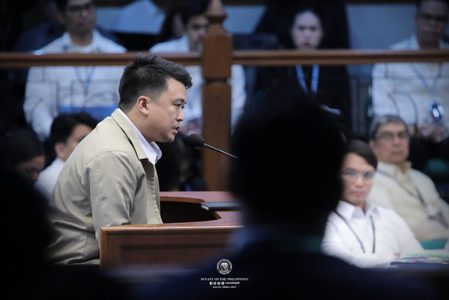
Of course, there is a current fear of deepfakes and AI, so Senator-judge Ping Lacson was justified when he said that it was practically impossible to check if a video is deepfake just by trusting your own eyes or by doing things manually.
Calilung said he only performed manual checking of the screen recording of the Facebook video in question. He manually compared the recorded and original videos for authenticity.
That process can establish whether the uploaded recording faithfully matches the original Facebook video, but by itself does not conclusively determine whether the original video had been synthetically generated or manipulated before it was uploaded.
Notably, Calilung attested to the fact that the NBI does have tools for video forensics: EnCase Forensic, Cellebrite, and Amped Authentic. But they didn’t use them.
Answering Lacson, Calilung attested to the authenticity of the video based on his manual checking, based on his own competence and “experience,” and his having appeared in at least 30 court hearings.
On his second day appearing as a witness, his credibility was tested again, and reiterated his certifications in hacking and forensics, having been trained by an expert in photo and video authentication, and newly surfaced information that he also has undergone training conducted by Interpol. (As Rappler’s John Nery notes in our livestream, maybe that should have been brought up sooner.)
Back to the tools. Why weren’t they used? Calilung said again it was due to the length. He also cited technical limitations relating to frame-rate analysis, although he did not elaborate on why those limitations prevented the software from being used on this particular video.
One possible explanation is that investigators concluded the video presented no obvious signs warranting further forensic testing, particularly given its length and the absence of visible anomalies during manual review.
Senator Tito Sotto also clarified whether Calilung was aware of content on Facebook now being labeled “AI Info.” Calilung said he was.
At this point, the senator-judges looked like they’re only playing devil’s advocate. So far there has been no hint that the defense would question whether the video was AI or not, precisely because you’d also need evidence too to begin looking at that angle. And so far, the prevailing belief is that it’s real.
In the end, Senator Alan Peter Cayetano clarified that Calilung is a “competent witness” but not an “expert witness.” And he said it would take an “expert witness” to verify whether the video is AI or not.
If the AI question should come up again, certainly the use of digital forensic tools would have, at the very least, helped bolster the witness’ case. – with reports from Victor Barreiro Jr./Rappler.com