
.png) 6 hours ago
2
6 hours ago
2

Upgrade to High-Speed Internet for only ₱1499/month!
Enjoy up to 100 Mbps fiber broadband, perfect for browsing, streaming, and gaming.
Visit Suniway.ph to learn
Jap Tobias - Philstar.com
September 27, 2026 | 12:40pm
MANILA, Philippines — There is a remarkable amount packed into Tanghalang Pilipino’s ongoing production of "Sayaw ng mga Ilaw": a child’s story of losing her father, a family’s experience of grief and a painful chapter of Philippine history that still stands, quite literally, in the city around us.
Adapted from Cheeno Marlo Sayuno’s award-winning children’s book, the production follows Laya, alternated by Wincess Jem Yana and Anika Co, who wants to learn Pandanggo from her sister Kala, played by Ynna Rafa. Their father, played by Noel Rayos, is a construction worker at the Manila Film Center. But one day, he does not come home.
Director Jonathan Tadioan, Juan Ekis and the creative team avoid turning the story into a straightforward history lesson. Instead, they build it through movement, music, dance and a child trying to understand why her father is gone.
A world built in motion

Tanghalang Pilipino / May Celeste
What makes the staging work is how much of the storytelling happens through the performers themselves. Benches and wooden poles become the construction site, bodies become workers and crowds, while pieces of fabric become costumes or part of the setting. The performers constantly move through the space and change it as the story unfolds.
The production also makes good use of Tanghalang Ignacio Gimenez itself.
Instead of keeping the action on a central stage, it places the main playing area to one side and uses the spaces around it. Performers move beyond the main stage, making the whole theater feel like part of the story. At times, especially for those seated close to the main playing area, following the action means turning your head to catch what is happening elsewhere in the space, reinforcing the production’s approach to staging and asking the audience to look around and take in the world being built around them.
This is especially effective in the construction scenes, where stacks of benches and wooden poles create a sense of danger. The enormous Filipiniana skirt that spills across the floor adds another layer of tension, as performers have to move around and through it, with even the possibility of tripping becoming part of the precariousness of the space.
All of this also demands a lot from the ensemble, and the performers meet that demand with remarkable commitment.
There is a strong sense of togetherness in the way they move, sing and build the world around Laya. Yana and Co bring childhood curiosity and vulnerability to Laya, while Rafa gives Kala the warmth of an older sister who is also carrying her own grief. Rayos makes Laya’s father feel like more than a symbol of the tragedy, while Shiela Valderrama brings warmth to the mother and stands out with her neat vocals.
Tanghalang Pilipino / May Celeste
When dance carries the story
The music gives "Sayaw ng mga Ilaw" much of its warmth, allowing the tenderness of family life and childhood wonder to exist alongside the story’s grief.
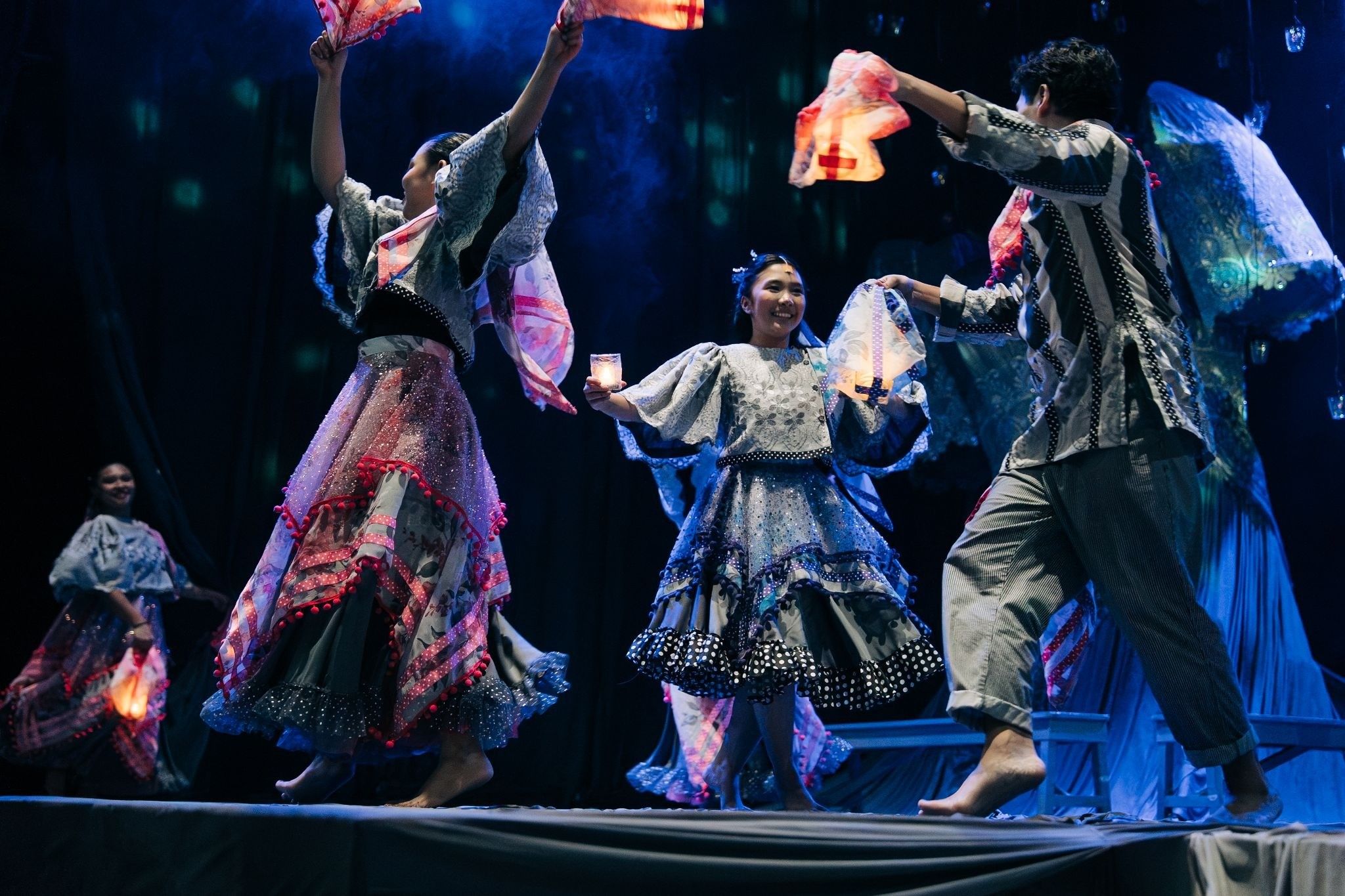
At the center of it is "Pandanggo sa Ilaw," which begins simply enough with Laya wanting to learn the dance from Kala. As her story unfolds, the dance takes on the weight of memory. The opening and closing Pandanggo sequences bookend that transformation, with the performers carrying lights through carefully choreographed movements that grow increasingly poignant as the meaning behind them becomes clearer.
The production also treats Filipino dance as a dramatic language. Bodies, gestures and formations convey relationships, tension and emotion, often without dialogue. Traditional movement is woven into the larger physical vocabulary of the production, giving the dance a role in telling the story rather than simply decorative.
Building history onstage
The production’s visual design is a masterclass in making every element of the stage carry meaning.
Designed by Marco Viaña, the enormous gray Filipiniana that dominates the stage is grand, almost like an editorial cartoon of the Marcos era brought to life. It immediately evokes the spectacle of the period’s “edifice complex,” but its meaning keeps shifting as the story unfolds, gradually carrying the weight of the people whose labor and lives were buried beneath that grandeur.
The skirt spills across the floor, wraps around the playing space and rises overhead to become a screen for projected historical footages from Ferdinand Marcos Sr.’s regime. Flickering lights and garments suspended overhead, at times descending into the playing space, add to the sense of lives caught between presence and absence.

Tanghalang Pilipino / May Celeste
That is the power of Viaña’s design: nothing feels merely decorative. The Filipiniana can suggest celebration and national spectacle, but it can also become a monument, a screen and a reminder of what lies beneath the grandeur.
Today, the Manila Film Center may simply be another imposing building along Roxas Boulevard, but through Laya’s story and this remarkable visual world, we are reminded of the ambition that built it, the people who paid the price for it and the history that should not be forgotten.
Bringing history into the light
Perhaps what "Sayaw ng mga Ilaw" does most meaningfully is make history personal.
By the final Pandanggo, the dance Laya once wanted to learn has acquired an entirely different meaning: what began as a lesson from her sister became a way for Laya to hold on to the memories of loss.
"Pandanggo sa Ilaw" is traditionally associated with fishermen, with its lights serving as guides through the darkness. In "Sayaw ng mga Ilaw," that image takes on a personal meaning as Laya finds her way through a loss she is still too young to understand, while the play brings attention back to the workers, families and lives forever changed by the Manila Film Center tragedy.
For a relatively short production, "Sayaw ng mga Ilaw" manages to hold so much: a family story, a history lesson, a celebration of Filipino movement and a meditation on grief and memory. More impressively, its music, dance, performances, lighting, projections, design and use of space never feel like separate pieces, but work seamlessly together to turn the entire theater into part of the story.
If anything, this production proves that a short material can still leave a long shadow. Through its many theatrical elements, it turns a painful history into an experience that is precise, imaginative and deeply human. And just like the lights that guide Laya through her grief, Sayaw ng mga Ilaw can guide a new generation toward the people and stories buried in our history, bringing them back into the light and ensuring that their memory never dims.
"Sayaw ng mga Ilaw" runs until October 11, 2026.
RELATED: Relearning Ka Oryang through 'Gregoria Lakambini' musical