59 minutes ago
3
59 minutes ago
3

Upgrade to High-Speed Internet for only ₱1499/month!
Enjoy up to 100 Mbps fiber broadband, perfect for browsing, streaming, and gaming.
Visit Suniway.ph to learn
Del Monte Philippines remains in an uncured contractual breach with SEA Diner Holdings (S) Pte. Ltd. That doesn’t mean outright bankruptcy, but the mid-2025 default notice put the violation on record, and the temporary truce expired on October 1. The silence since leaves investors in the dark about what, if anything, is holding back an immediate demand for cash.
Enforcement wouldn’t clear grocery shelves overnight. But because SEA Diner’s claim sits directly inside the profitable Philippine unit, any action would siphon off cash meant for operations and reinvestment to satisfy a senior creditor. The immediate threat is not missing pantry staples—it is the quiet loss of financial independence for the company producing them.
Every weekend across Metro Manila, supermarket carts tell a story of unshakable consumer trust. Into wire baskets go red-and-green cans of tomato sauce for family spaghetti, chilled pineapple juice for breakfast, and fruit cocktail for Sunday dessert. To the average grocery shopper, Del Monte represents effortless stability: a heritage staple whose products move off grocery shelves with clockwork regularity.
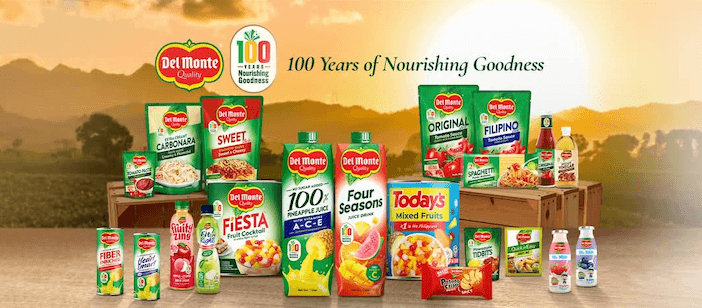 HERITAGE. Some of the products of Del Monte Philippines. Courtesy of Del Monte Philippines FB
 Few shoppers pushing those carts would ever suspect that behind those cheerful labels sits a company tiptoeing across an agonizingly thin financial wire.
The great paradox of Del Monte is that its core consumer business is genuinely thriving. People are not drinking less juice or cooking less pasta. Factories are humming, checkout lanes are busy, and Del Monte Philippines Inc. (DMPI)—the domestic operating powerhouse—remains remarkably profitable and cash-generative.
The trouble begins the moment that money leaves the factory floor and starts climbing the corporate ladder.
Think of Del Monte’s corporate structure as a sturdy, high-speed locomotive hooked to several overloaded, creaking carriages. Down on the tracks, DMPI is doing all the heavy hauling, generating practically all of the group’s operational earnings.
But up at the parent company, Del Monte Pacific Limited (DMPL), the picture changes completely. DMPL bears a massive wall of debt accumulated over years of aggressive leverage. Most of that load is short-term, meaning lenders expect to be repaid or refinanced right now, not years into the future.
Management argues that seasonal working-capital swings and revolving credit facilities keep the situation in check. But a revolving credit line is only as dependable as the banker holding the keys. When short-term liabilities outstrip liquid resources to this extent, lender goodwill ceases to be an operational cushion—it becomes the structural glue holding the entire house together.
The strain became impossible to hide when Del Monte had to ask regulators for extra time just to publish its annual financial statements. External auditors were not debating whether Filipinos still enjoy pineapple juice.
They held back their signatures because they required documented, interim commitments from lenders before certifying the company could survive another year without tumbling into default. While banks have not pulled the plug, agreeing to hold off on enforcing covenants today is very different from writing a committed, long-term check for tomorrow.
Regulators have since given Del Monte until November 30 to publish its FY2026 annual report and until December 22 to hold its annual meeting. The company’s September 17 disclosure said financing-counterparty discussions had not progressed in the manner or timetable experienced in earlier maturity extensions. It also said third-party valuation work tied to the former US subsidiary remained unfinished, leaving the audit and going-concern review dependent on work still outside management’s complete control.

Among the creditors waiting in the wings, Singapore-based SEA Diner casts the longest shadow. It owns barely a tenth of DMPI, but that slice comes armed with immense leverage: a redeemable preference stake worth over US$156 million, guaranteed dividends that compound aggressively when delayed, and legal veto power over major boardroom decisions.
That is why October 1 has become the date hanging over the entire enterprise. When Del Monte tripped covenants last year, SEA Diner slapped it with a default notice before agreeing to a temporary truce—one that ran strictly until the start of October.
Without a fresh standstill or a restructured deal, the clock finally runs out. SEA Diner gains the immediate legal muscle to demand its capital back with hefty returns, tightening its grip on the very cash engine keeping the entire empire afloat.
That outside date has now passed. As of October 5, Del Monte had announced neither another extension nor a completed restructuring of the preference shares. It had disclosed no Default Exercise Notice, redemption demand or enforcement action. Silence is not proof that SEA Diner has exercised its rights. But investors no longer know what, if anything, restrains those rights after the last publicly disclosed standstill expired.
The market’s reaction underscored the uncertainty. On October 2, the first trading day after the deadline, Del Monte Pacific closed at S$0.060, down 11.76% from the previous close and at its 52-week low.
Volume was more than three times its recent average. The timing does not prove causation, but the selloff shows how much weight investors placed on the unexplained deadline.
Look closer at the cash register, and the math becomes even starker. Even after a strong sales year, nearly all the free cash Del Monte squeezes out of operations is instantly spoken for before it can ever benefit ordinary public shareholders.
It flows immediately out the door to service massive interest bills, pay equipment leases, and appease outside preferred investors who hold first-priority claims on subsidiary earnings.
By the latest quarter, that cash engine was running so hot servicing obligations that it failed to generate enough cash to cover them. Management bridged the shortfall by selling off an old overseas investment—a tactical disposal that buys temporary breathing room, but one that cannot be repeated once the family silver is gone.
| THE NUMBERS BEHIND THE STORY | |||
| FY2026 sales US$896.1M (P51.9B) | Group net profit US$48.4M (P2.80B) | DMPI net income US$103.1M (P5.97B) | DMPI operating profit US$153.6M (P8.89B) +43% |
| FY2026 balance sheet pressure Cash: US$8.1M (P469M) Borrowings: US$985M (P57.0B) Current borrowings: US$714.3M (P41.4B) Current-liability deficit: US$787.2M (P45.6B) Negative equity: US$589.9M (P34.2B) | Pressure above DMPI Group obligations: about US$1.2B (P69.5B) Parent cash in July: US$114,000 (P7M) Parent current liabilities: US$514M (P31.58B) Hybrid preference claims: US$226.5M (P13.91B) Interest cover: DMPI 4.1x | Group 2.2x | ||
| Where FY2026 free cash flow went Free cash flow: US$111.8M (P6.47B) Cash interest: US$70.7M (P4.09B) Leases: US$13.2M (P764M) Minority dividends: US$18.7M (P1.08B) Remaining: US$9.3M (P538M) | 91.7% absorbed | Q1 FY2027 cash squeeze Free cash flow: US$10.5M (P645M) Interest leases and payouts: US$22.9M (P1.41B) Cash shortfall: US$12.5M (P768M) Sundrop sale proceeds: US$13.3M (P817M) Cash at July 31: US$4M (P246M) | ||
| Sources: Del Monte Pacific FY2026 results, Capital and Financial Recovery Plan, and Q1 FY2027 management discussion and analysis. Peso amounts are approximate equivalents. | |||
None of this means Del Monte products are about to vanish from grocery aisles. The sheer consumer power of the Philippine franchise is precisely why nervous financiers continue to sit at the bargaining table. They know the golden goose is still laying eggs.
The dilemma is who gets to keep them. Market popularity, operating health, and corporate solvency are three entirely different disciplines. A business can run one of the most profitable consumer brands in the country while remaining utterly powerless to prevent banks, bondholders, and preference financiers from intercepting every peso at the door.
For ordinary equity investors, that is the central predicament. Del Monte does not have a consumer product issue; it has a top-heavy capital structure problem.
Until the parent company permanently restructures its mountain of debt, satisfies its auditors, and defuses its ticking preference-capital deadlines, its most beloved household brand will simply be working overtime to service someone else’s balance sheet. – Rappler.com
Below are some Vantage Point pieces you might have missed:
Click here for other Vantage Point articles.